
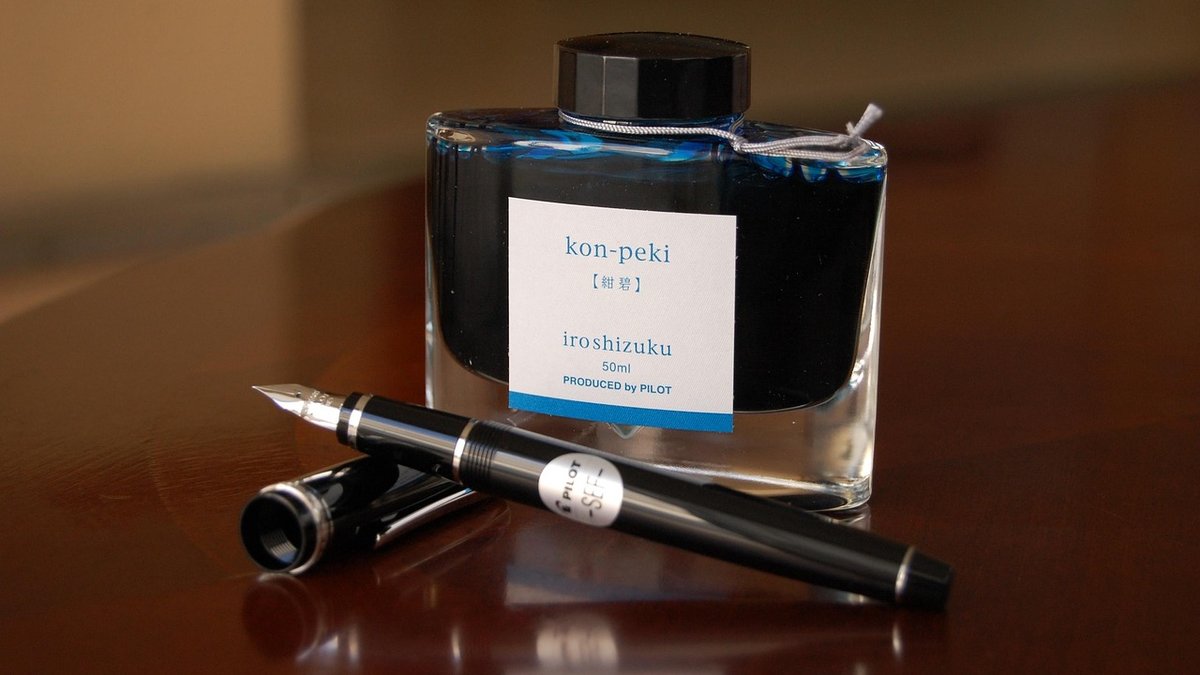
Most people start with the pen. It is the thing you hold, after all, and it is the thing that looks good on a desk. But once you have a fountain pen that writes without skipping, the ink inside it makes a far bigger difference to your everyday notes than the pen itself does. A modest pen filled with an ink you like will beat an expensive pen filled with something that feathers, smears or refuses to dry.
Ink is also the cheapest part of the hobby. A small bottle costs less than a decent notebook and will fill a converter dozens of times. That means you can experiment, change your mind, and settle on two or three favourites without much outlay at all. This guide is about getting to that point sensibly, rather than buying fifteen bottles in a fortnight and regretting twelve of them.
Beginners do best with a small, deliberately boring starting set. Pick one ink in each of these categories and use them for a month before buying anything else.
If you want a fourth, choose a warm colour — a burgundy, a brown or a deep green — for headings, underlining and marking up documents. One accent colour does more for the readability of your notes than three extra blues ever will.
Buy small bottles, ideally 30ml, or sample vials if you can get them. And be strict about one thing: fountain pen ink only. Drawing ink, calligraphy ink and Indian ink contain binders that will clog a feed, and no amount of flushing will fully rescue a pen you have left to dry with them inside.
Ink behaviour is a relationship between three things: the ink, the nib and the paper. Change one and the result changes.
A wet, broad nib on absorbent paper is where trouble starts. The ink spreads, letters grow fuzzy edges — feathering — and heavy strokes show through to the reverse, or bleed into the next page. The same ink in a fine nib on 90gsm paper will look sharp and controlled. If your writing is feathering, check the paper before you blame the ink.
One useful quirk: ink always looks darker from a fine nib, because less of it sits on the surface. A colour that seems pale in a broad nib may look almost black in a fine one.
Once the basics are settled, these are the three words you will meet next. They are worth understanding before you spend money chasing them.
All three are paper-dependent, which is why two people can describe the same ink completely differently. Treat them as a bonus, not a requirement.
Most ordinary inks are water-soluble. A spilled mug of tea will lift a page of notes into an unreadable grey wash. That is fine for drafts and diaries, and a problem for envelopes, labels, signed documents and anything you intend to keep for years.
The practical approach is to keep one pen loaded with a waterproof ink and use it for the jobs that need it. Everything else can stay cheerful and washable.
Keep a swatch book from day one: an index card per ink, with the name, the date, the pen and nib used, and a note of how long it took to dry on your usual paper. It takes seconds and saves you buying the same disappointing grey twice.
Beyond that, a few habits keep things tidy. Store bottles upright, out of direct sunlight and with the cap tight; most inks last for years, though some will eventually throw a little sediment. Never mix two inks inside a pen unless you know they are compatible — blend a few drops in a sample vial first and let it sit overnight. Flush pens between colour changes with plain water until it runs clear, and leave them to dry overnight before refilling.
Finally, resist the urge to have everything inked at once. Three pens in rotation, each with an ink you chose on purpose, will get used. Fifteen pens with fifteen half-forgotten colours will simply dry out, and you will spend your evenings cleaning them.

Hi, my name is Anthony kuber. I am artist and fashion designer.
I love to travel and writing blogging.
Your email address will not be published. Required fields are marked *
Software Developer & Writer
Hey, I'm Diva, a developer and writer blending code and creativity. I'm driven by a deep curiosity and a relentless pursuit of excellence. Join me as I craft digital solutions and captivating stories.


